Overview & Process Mechanics
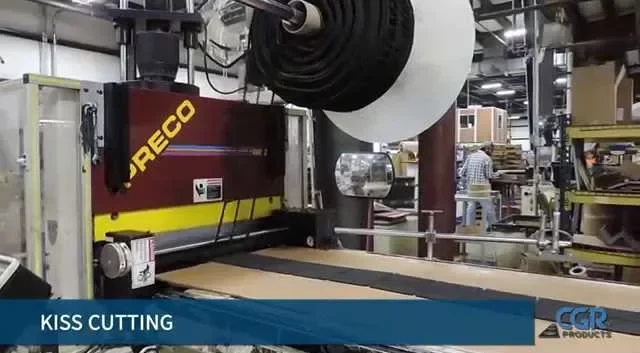
Kiss cutting is an ultra-precise die-cutting technique engineered to cut through the face material, primary substrate, and adhesive layer while leaving the underlying release liner intact and undamaged. This creates individual, dimensionally stable gaskets, pads, or seals supplied on a continuous backing carrier for streamlined manual peeling or high-speed robotic pick-and-place assembly lines.
At CGR Products, our converting centers operate multi-station rotary platforms and precision flatbed mechanical kiss presses equipped with micro-adjustable hardened anvil rolls and micrometer-calibrated mechanical positive stop blocks. By maintaining cutting depth control down to ±0.001″ (±0.025 mm), our tooling cleanly breaches adhesive matrices and high-performance foams without scoring, piercing, or compromising the tensile strength of the release liner.
Core Kiss Cutting Capabilities
-
Precision Depth Control: Ultra-tight mechanical tolerances allow die blades to cut through dense rubbers, open/closed-cell foams, or thin film adhesives without scoring or piercing the underlying paper or PET release liner.
-
Roll & Sheet Delivery Formats: Parts can be supplied in continuous rolled coils (with optional matrix removal) or cut into convenient flat sheets for manual or automated pick-and-place assembly.
-
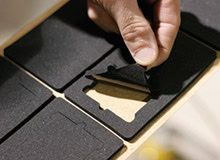
Waste / Matrix Removal (Weeding): Automated stripping removes the excess outer scrap material (matrix) surrounding the parts, leaving clean, isolated components on the liner for effortless peeling.
-
Extended Liner & Pull Tabs: Optional extended liners or custom pull-tab features can be engineered into the parts to speed up operator hand assembly and eliminate peeling frustration.
Precision Kiss Cutting Specifications & Converting Limits
CGR Products provides custom kiss cutting services for continuous peel-and-stick component delivery across automotive, electronics, medical, and industrial manufacturing lines. Using multi-station rotary platforms (including continuous Delta ModTech lines) and precision-guided flatbed presses, our converting process cuts through single- or multi-layer substrates and pressure-sensitive adhesives to an exact depth tolerance while preserving the integrity of the underlying carrier liner.
| Engineering Parameter | Capability Range & Technical Limit | Tooling & Operational Notes |
|---|---|---|
| Cutting Depth Tolerance | ±0.001″ (±0.025 mm) | Micrometer anvil positioning eliminates liner scoring, fracture, and premature tensile failure. |
| Material Thickness Capacity | 0.001″ films up to 0.375″ (9.5 mm) elastomeric foams | Covers ultra-thin PSA transfer tapes up to thick microcellular PORON® and sponge rubbers. |
| Maximum Web / Sheet Width | Rotary: Up to 24″ web width Flatbed: Up to 40″ × 60″ platen area |
High-speed rotary accommodates high-volume continuous coils; large-bed presses process multi-cavity sheets. |
| Tooling Architectures | Solid engraved hardened cylinders, flexible magnetic dies, precision steel rule dies | Flexible magnetic dies allow rapid prototyping; solid tool steel maximizes continuous die longevity. |
| Compatible Release Liners | Polyester (PET film: 1.0 to 3.0 mil), Densified Kraft (DK), Polycoated Kraft (PCK) | High-tensile PET film liners prevent web snap on high-speed automated robotic pick-and-place lines. |
| Delivery Formats | Continuous wound rolls, kiss-cut pads/cards, perforated strips, fan-folded packs | Supplied with optional registration eye marks, pin-feed sprockets, or custom roll core diameters (3″ or 6″). |
| In-Line Secondary Operations | Waste matrix stripping (weeding), slug removal, extended pull tabs, multi-layer lamination | Executed in a single synchronized machine pass to eliminate secondary conversion handling. |
| Adhesive & Substrate Systems | 3M™ VHB™, acrylic & rubber PSAs, silicone adhesives, PORON®, Neoprene, EPDM, silicone sponge | Compatible with selective zone lamination and differential adhesives (different tack on face vs. liner side). |
Frequently Asked Questions:
What is kiss cutting?
Kiss cutting is a specialized die cutting process where the top material and pressure-sensitive adhesive are cut through completely, but the protective release liner backing remains untouched and continuous.
What are the main benefits of kiss-cut parts for manufacturing?
Kiss-cut parts dramatically reduce assembly time by providing “peel and stick” convenience. Parts stay neatly organized on rolls or sheets, preventing damaged edges, lost components, and tedious liner removal.
What is matrix removal (weeding) in kiss cutting?
Matrix removal is the process of stripping away the excess scrap material around the die-cut parts after cutting. This leaves only the finished parts cleanly exposed on the continuous backing paper, making them faster to pick and apply.
How do tooling design and anvil controls prevent liner strike or fracture during kiss cutting?
Maintaining liner integrity requires managing kiss-cutting blade heights down to tight micrometer tolerances. In rotary die converting, we use hardened precision anvil rolls paired with solid CNC-machined steel or flexible magnetic dies where the blade-to-anvil clearance matches the exact combined gauge of the substrate and adhesive layer. By maintaining a uniform bearing surface, the die edge pierces the elastic foam or film and stops within 0.0005″ of the liner surface, eliminating micro-scores that could cause web breaks under tension.
Can kiss-cut parts be engineered for automated robotic pick-and-place dispensing?
Yes. For automated peel-and-stick assembly, CGR Products delivers parts on high-tensile polyester (PET) film release liners rather than paper backing to eliminate web breakage under dynamic feeder acceleration. Furthermore, our rotary converting platforms can punch optical sensor registration holes, tractor pin-feed perforations, or print continuous timing marks directly onto the liner edge, ensuring consistent pitch and indexing alignment on high-speed robotic surface-mount or gantry systems.