CGR Products can supply a full range of EMI-RFI (Electromagnetic Interference – Radio Frequency Interference) shielding materials into a wide variety of die cut gaskets and seals.
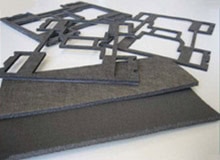

Modern electronic equipment often requires EMI Gaskets to avoid radiation of interfering frequency waves to other electronic sources. Maintaining electromagnetic compatibility can be an increasing challenge of the designers of today’s electronic and electrical products.

EMI & RFI Shielding Materials & Converting Capabilities
CGR Products fabricates and die-cuts high-performance electromagnetic interference (EMI) and radio frequency interference (RFI) shielding materials. We convert electrically conductive elastomers, metal foil tapes, fabric-over-foam gaskets, and wire mesh composites engineered to prevent signal degradation, ensure electromagnetic compatibility (EMC), and maintain environmental enclosure sealing. Please view the table below for a complete list of EMI/RFI shielding materials.
| Shielding Material | Description | Suppliers & Specs |
|---|---|---|
| Electrically Conductive Elastomers | Silicone and fluorosilicone binders filled with conductive metal particles (nickel-graphite, silver-aluminum, silver-copper, or pure silver). Delivers broadband shielding effectiveness exceeding 90 to 120 dB across 10 MHz to 10 GHz while providing a continuous environmental seal against moisture, dust, and weather (MIL-DTL-83528 compliant). | Parker Chomerics · Rogers BISCO® · Specialty Silicone Products |
| Metal Foil Shielding Tapes | Dead-soft copper, aluminum, and embossed tin-plated copper foils laminated with conductive acrylic pressure-sensitive adhesive. Provides reliable point-to-point electrical contact, static charge draining, cable wrap grounding, and seam sealing in electronic cabinets. UL 510 flame retardant. | 3M™ (1181, 1245, 1170) · Avery Dennison |
| Fabric-Over-Foam Gaskets | Nickel-copper or silver-plated ripstop conductive fabrics wrapped over highly resilient open-cell polyurethane or thermoplastic elastomer foam cores. Requires exceptionally low closure force to achieve electrical grounding, making it ideal for thin stamped sheet metal housings, plastic enclosures, and access panels. | Laird Performance Materials · Schlegel Electronic Materials |
| Oriented Wire in Silicone | Individual monel or aluminum wire conductors embedded perpendicular to the flange face within solid or sponge silicone rubber. Offers high point-pressure electrical contact that penetrates non-conductive surface oxides, providing simultaneous EMP protection, high-decibel shielding, and IP65/IP66 weatherproofing. | Parker Chomerics · Leader Tech |
| Knitted Wire Mesh | Interlocking wire loops knitted from monel, tin-plated copper-clad steel (Sn/Cu/Fe), or aluminum wire, available all-mesh or over an elastomeric neoprene or silicone core. Resists extreme temperatures, provides rugged mechanical durability, and offers superior magnetic (H-field) and plane-wave shielding in heavy cast enclosures. | Parker Chomerics · Tech-Etch |
| Conductive Carbon & Graphite Foams | Open-cell polyurethane and microcellular urethanes loaded with conductive carbon black or coated graphite matrices. Provides controlled surface resistivity (anti-static to static dissipative) along with mechanical shock absorption and acoustic dampening for delicate circuit board assemblies. | Rogers PORON® · Zotefoams |
| Ferrite & Magnetic Absorber Sheets | Polymeric elastomer sheets filled with magnetic ferrite flakes engineered to absorb and attenuate high-frequency electromagnetic noise (near-field EMI) rather than reflecting it. Ideal for RFID tuning, mobile communication devices, wireless charging coils, and high-speed CPU cavity resonance damping. | 3M™ (AB5000 Series) · Fair-Rite |
We can supply shielding capabilities into diverse markets such as electronics, aerospace, medical, and data centers
CGR Products offers a wide variety of die cutting capabilities and lamination of materials with adhesive backing. Our Capabilities and 4 locations allow us to handle high volumes for OEM applications.
Contact Us today to start on your next project.
Frequently Asked Questions: EMI / RFI Shielding Gaskets & Converting
What is the primary difference between EMI shielding and EMI absorption?
The primary difference is how the material handles unwanted electromagnetic radiation:
- EMI Shielding Materials: Electrically conductive materials (such as metal foil tapes, conductive silicone, and wire mesh) reflect electromagnetic waves back toward the source or conduct the induced electrical current to ground, preventing radiation from passing into or out of an enclosure.
- EMI Absorber Materials: Magnetic materials (such as ferrite-loaded polymer sheets) absorb electromagnetic energy and convert it into minute amounts of thermal dissipation, eliminating internal resonance and near-field interference without reflecting stray signals back onto adjacent circuit board components.
How do conductive elastomer gaskets provide both environmental sealing and EMC shielding?
Conductive elastomers use a base carrier of high-grade silicone or fluorosilicone that is uniformly dispersed with microscopic conductive metal particles (such as silver-aluminum or nickel-graphite). When compressed between mating metal flanges, the elastomer conforms to surface imperfections to block water and dust intrusion up to IP65/IP66 ratings, while the overlapping metal particles form continuous microscopic contact pathways that establish low-resistance electrical grounding across the joint.
How do engineers avoid galvanic corrosion when specifying EMI gaskets?
Galvanic corrosion occurs when two electrochemically dissimilar metals make contact in the presence of moisture. To prevent corrosion and joint degradation, the conductive filler in the gasket must be matched to the enclosure flange metal:
- Aluminum Enclosures: Specify silver-plated aluminum or nickel-graphite filled elastomers to match galvanic potentials and prevent sacrificial aluminum oxidation.
- Stainless Steel or Tin-Plated Flanges: Nickel-graphite, monel mesh, or tin-plated copper conductive composites provide optimal electrochemical compatibility.
- Harsh Marine/Salt-Fog Environments: Specify dual-bead gaskets (an outer non-conductive fluorosilicone weather seal combined with an inner conductive EMI bead) to keep moisture completely away from the electrical contact interface.
When should fabric-over-foam be chosen instead of conductive silicone rubber?
Fabric-over-foam (FOF) is chosen when the enclosure housing has low closure force or thin, easily warped walls, such as thin sheet metal enclosures, plastic electronic covers, or server rack doors. FOF gaskets require very light compression deflection to achieve electrical grounding and high attenuation (typically over 80 to 100 dB). Conductive silicone requires higher bolt torque and rigid mating flanges to achieve both gasket deflection and electrical continuity.
What precision converting methods does CGR Products use for EMI shielding gaskets?
CGR Products converts EMI/RFI materials using precision rotary die cutting with kiss-cut liners for continuous roll presentation, CNC flatbed knife cutting for prototype validation, and CNC abrasive waterjet cutting for conductive silicone sheets and thick composite profiles. We also apply conductive acrylic pressure-sensitive adhesives using cleanroom-capable rotary lamination to ensure conductivity across the adhesive layer.