For die cut gaskets and seals, silicone rubber is a unique, extremely flexible synthetic elastomer.
It is also versatile and easy to color, making it simple to manufacture. For many manufacturers, silicone rubber stands out for its adaptability and durability.
High-quality silicone rubber gaskets and seals are resistant to aging, heat, and sunlight, as well as many oils and chemicals. Because rubber made from silicone is suitable for components used in high temperature environments, it is a top choice for engineers.
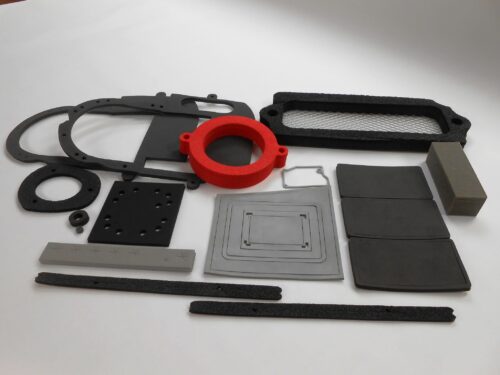
In addition, silicone can be exposed to wind, rain, and UV rays for extended periods of time with virtually no change in its physical properties. Many industries value how this material maintains performance through challenging conditions. Additional material properties include:
- High and low temperature stability is one reason it is chosen for critical engineering projects.
- Compression resistance is a key attribute of silicone rubber materials.
- Tear strength is reliable in various demanding environments.
- Varying degrees of hardness and softness make it adaptable for many uses.
Silicone Rubber Grades & Converting Specifications
CGR Products precision converts, die-cuts, waterjet-cuts, and laminates solid silicone rubber (VMQ) sheet and roll goods. Renowned for its wide thermal operating envelope (-80°F to 450°F+), zero ozone degradation, and inert chemical profile, solid silicone delivers long-term sealing performance in demanding industrial, medical, and aerospace applications. Please view the table below for our primary solid silicone grades.
| Silicone Grade | Mechanical & Environmental Profile | Durometer & Standards |
|---|---|---|
| Commercial Solid Silicone | General-purpose solid elastomer engineered for extreme thermal stability (-80°F to 450°F continuous). Impervious to ultraviolet radiation, ozone cracking, corona discharge, and moisture. Delivers low compression set and consistent elasticity across wide temperature swings for industrial flange and enclosure seals. | 40 to 80 Shore A · ASTM D2000 FC/FE · Red/Orange, Gray, Black |
| FDA Food-Grade Silicone | Manufactured with FDA-sanctioned ingredients for direct and indirect food contact. Odorless, tasteless, non-toxic, and resistant to animal fats and sanitizing washdowns. Commonly fabricated into sanitary flange gaskets, food processing seals, and beverage dispensing lines. | 30 to 80 Shore A · FDA 21 CFR 177.2600 · NSF-51 · White, Translucent |
| Medical & USP Class VI Silicone | Platinum-cured high-purity elastomer delivering ultra-low extractables and superior biocompatibility. Withstands repeated autoclave steam sterilization, gamma irradiation, and EtO gas processing without embrittlement or property degradation. | 40 to 70 Shore A · USP Class VI · ISO 10993 · Translucent |
| High-Tear Strength Silicone | Engineered with advanced polymer chains to resist notch propagation, flex fatigue, and mechanical tearing under dynamic joint deflection. Provides tensile strength up to 1,200+ PSI and tear resistance exceeding 200 PPI, making it ideal for high-cycle door seals and pump diaphragms. | 40 to 70 Shore A · ASTM D624 Die B · Gray, Translucent |
| Flame-Retardant Silicone | Formulated with inorganic non-halogenated flame retardants to self-extinguish upon ignition. Meets stringent mass transit, aviation, and electronics fire/smoke/toxicity (FST) safety protocols while maintaining environmental IP sealing. | 50 to 70 Shore A · UL 94 V-0 · FAR 25.853 · Gray, Black |
| Fluorosilicone (FVMQ) | Combines the wide temperature range of silicone (-80°F to 400°F) with the chemical and hydrocarbon resistance of a fluorocarbon. Specifically resistant to aviation jet fuel, automotive gasoline, synthetic engine oils, and harsh solvents where standard silicone swells and fails. | 40 to 80 Shore A · MIL-DTL-25988 · Blue/Blue-Gray |