While foam rubber has a noticeable bounce and cushion to it, there are some applications for gaskets and seals that better benefit from a more durable, resistant material such as solid rubber.
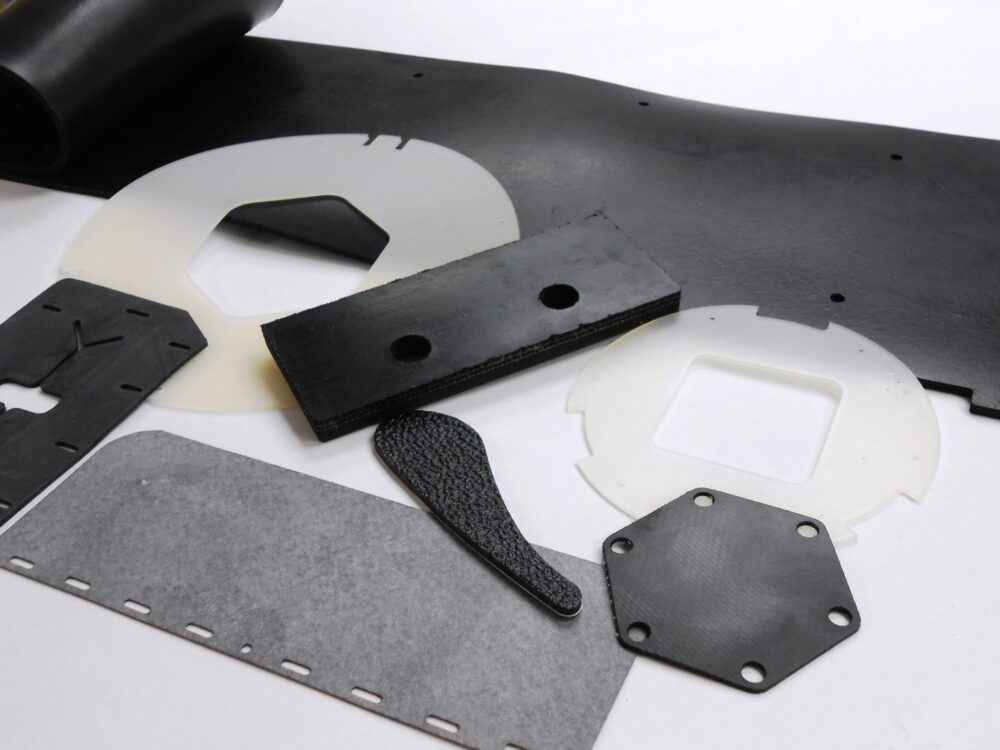
Most people are familiar with the type of solid rubber used in manufacturing being similar to that of a car tire. It also has a wide variety of uses as a gasket or a seal.

Solid rubber has almost all the same properties as foam or sponge except without the cushion created by air. Creating a gasket or seal with solid rubber will make a durable, leak-proof seal, but will not absorb as much impact as a product made from an open or closed cell sponge. Rubber of all types is very versatile as it carries natural resistant properties, but can also be treated for use in specific industries.
Depending on the elastomer compound selected, solid rubber gaskets can withstand internal pressures exceeding 500 PSI, with specialized materials operating across extremes from -80°F up to 450°F (such as silicone and fluoroelastomers), while general utility grades provide dependable service from -20°F to 170°F.
Solid Rubber Elastomer Selection Matrix & Converting Capabilities
CGR Products converts solid dense elastomeric sheet and roll goods for heavy-duty sealing, high-bolt-load fluid containment, chemical isolation, and mechanical vibration damping. Unlike cellular sponge rubbers, solid elastomers provide high tensile strength, exceptional tear resistance, and continuous fluid impermeability under mechanical bolt loads. Review the comparative elastomer table below to evaluate temperature tolerances, durometer hardness, and chemical resistance profiles.
| Elastomer Polymer | Hardness (Shore A) | Continuous Temp Range | Chemical & Environmental Resistance Profile | Target Industrial Applications |
|---|---|---|---|---|
| Silicone (VMQ) | 30 to 80 Shore A | -80°F to 450°F (-62°C to 232°C) | Extreme temperature stability, ozone, UV, corona discharge, fungal growth. FDA food contact, USP Class VI medical grades available. Poor fuel/oil resistance. | Medical fluid handling, food processing equipment, high-temp oven seals, outdoor lighting enclosures. |
| Neoprene (CR / Chloroprene) | 40 to 80 Shore A | -30°F to 220°F (-34°C to 104°C) | Balanced all-around mechanical strength. Moderate resistance to petroleum oils, greases, refrigerants, sunlight, ozone, and atmospheric weathering. | Refrigeration compressors, HVAC flange gaskets, bridge bearing pads, marine equipment hatch seals. |
| Nitrile / Buna-N (NBR) | 40 to 90 Shore A | -30°F to 250°F (-34°C to 121°C) | Industry standard for petroleum hydrocarbons, diesel fuel, crude oil, hydraulic fluids, and mineral oils. Low gas permeability. Degrades in ozone and strong ketones. | Fuel pump diaphragms, automotive transmission gaskets, hydraulic reservoir seals, oilfield pipe flanges. |
| EPDM (Ethylene Propylene) | 40 to 80 Shore A | -40°F to 275°F (-40°C to 135°C) | Exceptional resistance to outdoor weathering, ozone, UV, steam, hot water, dilute acids, and brake fluids. Incompatible with petroleum oils and hydrocarbon solvents. | Automotive radiator seals, municipal water piping, steam line gaskets, exterior solar panel perimeter seals. |
| Viton® / Fluoroelastomer (FKM) | 60 to 90 Shore A | -15°F to 400°F (-26°C to 204°C) | Highest chemical and thermal endurance. Resists aggressive fuels, aromatic hydrocarbons, concentrated acids, and synthetic lubricants. Excellent vacuum retention. | Aerospace fuel systems, chemical plant process piping, automotive fuel injection manifolds, oil refinery pumps. |
| SBR / Red Rubber (Styrene-Butadiene) | 60 to 80 Shore A | -20°F to 170°F (-29°C to 77°C) | Economical utility rubber offering good physical abrasion resistance and mechanical resilience. Conforms easily to uneven pipe flanges. Poor oil/weather resistance. | Low-pressure water pipe flanges, general plumbing seals, low-duty utility air lines, HVAC mechanical spacers. |
| Natural Gum Rubber (Isoprene) | 35 to 60 Shore A | -40°F to 180°F (-40°C to 82°C) | Unrivaled tensile strength (up to 3,000+ psi), ultimate elongation (>600%), and mechanical tear/abrasion resistance. Poor resistance to oils, ozone, and UV. | Slurry pump liners, sandblast cabinet curtains, flexible chutes, dynamic impact wear bumpers. |
| Cloth-Inserted Rubber (CI SBR / CI Neoprene) | 60 to 75 Shore A | -20°F to 180°F (-29°C to 82°C) | Reinforced with 1 to 4 plies of woven polyester, nylon, or cotton duck. Prevents creep, cold flow, and bolt-hole extrusion under high flange torque. | High-compression water meter gaskets, hydraulic pump mounting pads, high-bolt-load pipe flanges. |