Cloth-inserted SBR is suitable for use against cold or hot water, air, gas, or any application requiring firm gaskets that need a fabric to resist cold flow.
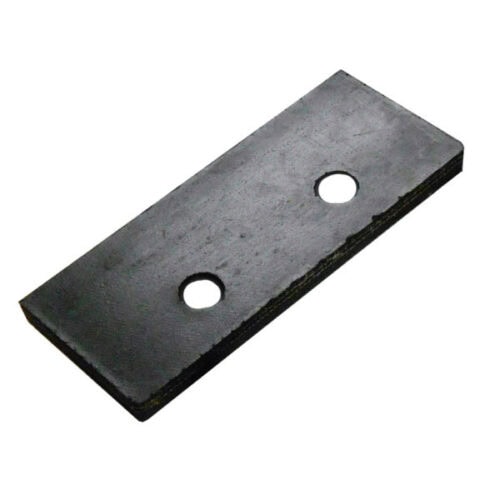
SBR can enhance the stability in flanged gasket applications with high compression loads. It also offers a smooth finish.
Cloth-Inserted (CI) SBR Rubber Grades & Converting Specifications
CGR Products precision converts, slits, laminates, and die-cuts cloth-inserted styrene-butadiene rubber (CI SBR) sheet and roll goods. By embedding high-tenacity textile fabrics—such as polyester, nylon, or cotton duck—within dense elastomeric SBR, cloth-inserted sheet provides exceptional dimensional stability, eliminates lateral creep and cold flow, and prevents bolt-hole tear-out under heavy flange torque. Review the comparative ply and specification matrix below to select the optimal reinforcement structure for your piping or mechanical application.
| Reinforcement & Grade | Mechanical & Environmental Profile | Durometer & Standards |
|---|---|---|
| 1-Ply Polyester Reinforced SBR | Standard utility high-pressure flange material (typically 1/16″ to 1/8″ thickness). The centered woven polyester fabric ply arrests lateral creep, stops bolt-hole distortion, and retains surface sealing conformability on cold/hot water, air, and low-pressure saturated steam lines up to 180°F (82°C). | 65 to 75 Shore A · ASTM D2000 AA · Smooth/Fabric Finish · Red or Black |
| Multi-Ply (2 to 4 Ply) Heavy CI SBR | Engineered for heavy-gauge sheet (3/16″ to 1/2″+ thickness) and severe mechanical compression. Multiple alternating textile plies distribute compressive bolt stress evenly, preventing extrusion and edge blowout under dynamic line surges in water treatment, pump casings, and municipal valve bodies. | 70 to 80 Shore A · Severe Mechanical Load · Multi-Ply · Red or Black |
| Cotton Duck Inserted SBR | Traditional heavy-weave cotton duck canvas reinforcement embedded within SBR. Offers superior mechanical cushioning, high damping modulus, and exceptional tear resistance for structural mounting pads, machinery isolation shims, and heavy-duty vibration isolators. | 70 to 80 Shore A · Heavy Duck Canvas · High Damping · Black |
| Nylon-Reinforced High-Tensile CI SBR | Combines SBR rubber with high-strength woven nylon filament fabric. Provides maximum flex fatigue endurance, cut-growth resistance, and burst strength, making it ideal for dynamic pump diaphragms, flexible air duct transitions, and heavy-duty chute sleeves. | 60 to 75 Shore A · Dynamic Flex / High Tensile · Black |
| Red CI SBR Flange Sheet | The classic red utility rubber enhanced with an internal fabric reinforcement. Combines the conformability of traditional red rubber on rough cast-iron surfaces with the anti-extrusion strength of woven fabric under standard ANSI 150# bolt torque. | 65 to 75 Shore A · ANSI 150# Rated · Red Sheet |
Frequently Asked Questions: Cloth-Inserted (CI) SBR Gaskets & Fabrication
What is the primary engineering purpose of cloth insertion in SBR rubber gaskets?
Solid rubber is incompressible (meaning it displaces constant volume under load) and tends to deform laterally when subjected to heavy mechanical clamping. In bolted pipe flanges, this causes cold flow, creep relaxation, and gasket extrusion outward away from bolt holes, leading to lost bolt pre-load and joint leakage. Embedding woven textile plies (polyester, nylon, or cotton duck) provides structural tensile reinforcement that restricts lateral displacement, eliminates bolt-hole elongation, and maintains joint torque retention while preserving the outer rubber’s ability to seal surface tool marks.
How do engineers determine whether to specify 1-ply or multi-ply cloth reinforcement?
The choice between single and multi-ply fabric reinforcement depends on sheet thickness and internal line pressure:
- 1-Ply Reinforcement: Standard for nominal thicknesses between 1/16″ (0.062″) and 1/8″ (0.125″). A single centered fabric layer provides sufficient tensile stability to resist blowout and bolt-hole elongation in typical ANSI Class 125/150 flanges.
- Multi-Ply (2 to 4 Plies): Specified for heavier thicknesses (3/16″, 1/4″, and up to 1/2″) or severe pressure cycles exceeding 150 PSI. Distributing multiple fabric layers evenly through the cross-section prevents the thick rubber core from rolling or extruding under high flange compression.
What operating temperature and fluid limitations apply to cloth-inserted SBR?
Cloth-inserted SBR operates across a continuous service temperature range of -20°F to 180°F (-29°C to 82°C). It is formulated for water (cold, hot, municipal), saturated low-pressure steam, utility air lines, and mild non-corrosive aqueous solutions. CI SBR is strictly incompatible with petroleum fuels, motor oils, hydraulic fluids, and outdoor ozone/UV radiation, which attack both the SBR polymer and the internal fabric matrix. For oil service with cloth reinforcement, specify Cloth-Inserted Neoprene or CI Nitrile.
Does the embedded cloth create a potential wicking or fluid leak path?
In properly manufactured cloth-inserted sheet, the vulcanized rubber completely encapsulates the woven fibers, preventing fluid transfer. However, in applications involving high-pressure fluids or highly permeable liquids, the cut edge of the fabric ply can theoretically wick moisture if cut poorly or exposed to chemical degradation. CGR Products eliminates edge fiber fraying and loose threads by utilizing tight-tolerance mechanical die stamping or high-velocity CNC abrasive waterjet cutting to yield sealed, cleanly sheared edges.
What precision manufacturing methods does CGR Products use to fabricate CI SBR gaskets?
Because the internal woven fabric creates high shear resistance and can dull standard tooling faster than homogeneous rubber, CGR Products utilizes:
- High-Tonnage Mechanical Flatbed Presses: Hardened tool-steel dies stamp high-volume ANSI 150# full-face and ring gaskets with clean bolt holes and no fabric fraying.
- Multi-Head CNC Waterjet Cutting: High-pressure waterjet streams slice heavy multi-ply slabs up to 1/2″ thick without edge compression, concavity, or delamination, ideal for large-diameter flanges and rapid prototyping without tooling costs.
- Rotary Hot-Roll Adhesive Lamination: Applying high-shear acrylic or synthetic rubber pressure-sensitive adhesives (PSA) with extended peel liners for rapid assembly placement.
Cloth-Inserted SBR Gasket Engineering & High-Volume OEM Converting
CGR Products partners directly with water meter, industrial pump, and equipment OEMs to engineer precision cloth-inserted rubber gaskets. From ply construction validation and ASTM D2000 callouts to high-capacity mechanical die stamping, large-bed CNC waterjet slicing, and custom adhesive laminating, our multi-plant converting facilities deliver consistent quality at production scale.