CGR’s natural rubber sheet is a very high quality material, pure gum floating stock with high abrasion resistance.
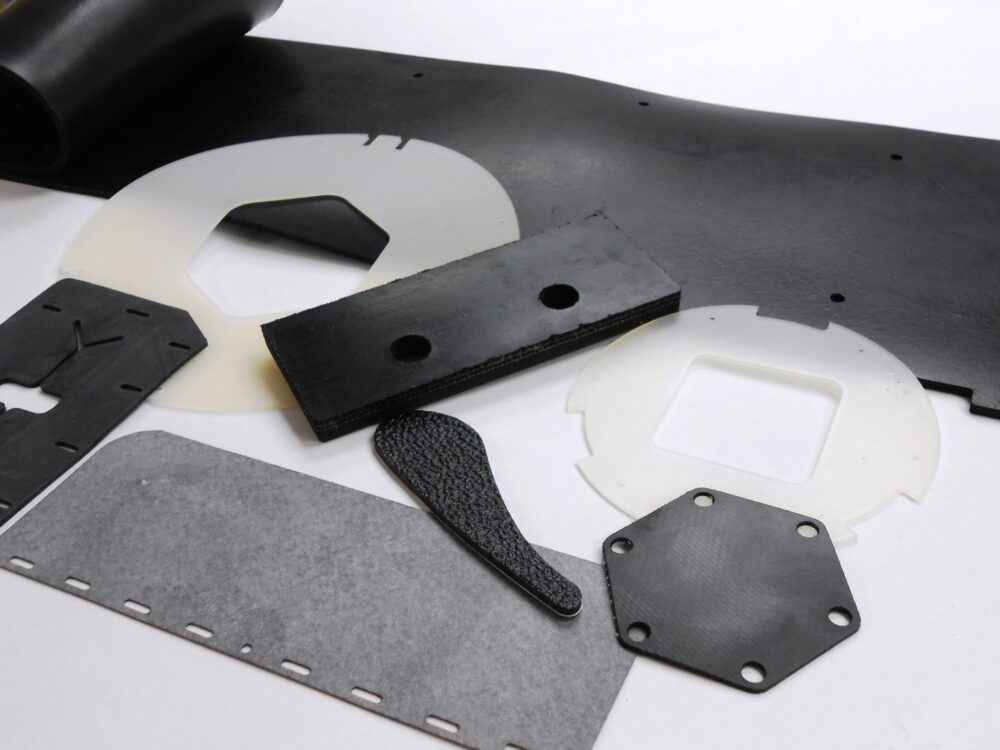
Natural rubber sheet is excellent for use on low bolt flanges where surfaces are rough or irregular. It is available in thicknesses from 1/16″ to 1″ and also offers a smooth finish.
Natural Rubber (Pure Gum) Grades & Converting Specifications
CGR Products precision converts, slits, laminates, and die-cuts natural rubber (polyisoprene / pure gum rubber) sheet and roll goods. Renowned for industry-leading tensile strength (up to 3,000+ PSI), extreme elongation (>600%), and exceptional tear and wet-slurry abrasion resistance, natural gum rubber delivers long-term elasticity and mechanical compliance. Review the comparative grade matrix below to select the optimal durometer, color formulation, and application profile for your sealing or lining project.
| Natural Rubber Grade | Mechanical & Environmental Profile | Durometer & Standards |
|---|---|---|
| Pure Gum Natural Rubber | Premium non-synthetic, unpigmented virgin polyisoprene. Features unrivaled tensile strength (up to 3,000 PSI), outstanding elasticity, and superior resistance to cut growth and dynamic fatigue. Conforms effortlessly to uneven or cast-iron flange faces under low bolt torque across a service range of -40°F to 180°F (-40°C to 82°C). | 35 to 45 Shore A · ASTM D2000 AA · Ultra-Soft / High Stretch · Tan/Amber |
| Abrasion-Resistant Slurry Grade (Red/Black) | Formulated specifically for severe dynamic mechanical wear and hydraulic slurry impingement. Deforms elastically under high-velocity particle impact and rebounds without surface erosion, outlasting hardened steel and synthetic elastomers in wet-abrasive environments. | 40 to 60 Shore A · High Tear / Cut Resistant · Red or Black |
| Commercial Natural Rubber Blend | Economical blend of natural polyisoprene with synthetic SBR or filler polymers. Delivers good mechanical resilience, moderate abrasion resistance, and excellent vibration dampening for non-critical industrial bumpers, chassis pads, and general utility water seals. | 50 to 70 Shore A · ASTM D2000 AA · Smooth Finish · Black |
| Protein-Free Synthetic Polyisoprene (IR) | Synthetic identical molecular analogue of natural rubber produced via solution polymerization. Delivers the identical high tensile, elongation, and elastic recovery of natural gum rubber without the natural latex plant proteins, eliminating Type I latex allergic reactions in sensitive equipment. | 40 to 60 Shore A · Hypoallergenic / Latex-Free · Translucent / Light Amber |
| FDA Food-Grade Natural Rubber | Compounded with non-toxic, non-marking ingredients for direct or indirect food handling, dairy processing, and grain conveyance. Highly resilient for flexible chute sleeves, transfer boots, and valve seals handling dry bulk solids and aqueous foodstuffs. | 40 to 60 Shore A · FDA 21 CFR 177.2600 · White / Off-White |
Frequently Asked Questions: Natural Rubber Gaskets & Fabrication
What mechanical advantages make Natural Gum Rubber unique compared to synthetic elastomers?
Natural rubber (cis-1,4-polyisoprene) delivers the highest tensile strength (exceeding 3,000 PSI) and ultimate elongation (600% to 800%) of any general-purpose elastomer. Its unique strain-crystallizing polymer structure gives it unrivaled resistance to mechanical cut propagation, tear fatigue, and dynamic abrasive wear. In wet slurry, aggregate chute, and sandblast applications, soft gum rubber deforms elastically to absorb particle impact energy and snaps back without gouging, drastically outlasting hardened metals and synthetic rubbers.
What operating temperature limits apply to natural rubber gaskets?
Solid natural rubber operates across a continuous service temperature range of -40°F to 180°F (-40°C to 82°C). While it provides exceptional low-temperature flexibility down to -40°F without becoming brittle, operating temperatures exceeding 180°F accelerate oxidative softening and polymer reversion. For continuous service temperatures above 200°F, high-temperature elastomers like EPDM (up to 300°F) or Silicone (up to 450°F) are recommended.
Can natural rubber gaskets be exposed to petroleum oils, fuels, or outdoor ozone?
No. Natural rubber is strictly incompatible with petroleum hydrocarbons, mineral oils, solvents, and outdoor ozone/UV radiation. The double bonds in its polyisoprene backbone are rapidly attacked by atmospheric ozone, causing severe surface crazing and cracking under tension. Contact with motor fuels, hydraulic oils, and greases causes severe swelling and rapid structural breakdown. Specify Nitrile (Buna-N) for petroleum oils or EPDM for outdoor weather and ozone exposure.
Why is natural gum rubber preferred for low-bolt-load and uneven flanges?
Because pure gum rubber is available in very soft durometers (35 to 45 Shore A) with high elasticity, it requires minimal bolt pre-load to flow and seal. It conforms readily across warped, rough-cast, pitted, or lightweight plastic and fiberglass flanges without requiring high torque that could crack delicate mating components or warp thin sheet-metal housings.
What precision fabricating methods does CGR Products use to cut soft natural rubber?
Soft gum elastomers (35–50 Shore A) can deform laterally under mechanical knife or die pressure, resulting in concave edge walls. CGR Products resolves this by using multi-head CNC abrasive and pure waterjet cutting systems. Waterjet cutting exerts zero downward mechanical tool pressure, yielding perfectly vertical 90-degree edge cuts and exact bolt-hole diameters on thick rubber sheets (up to 1″ or thicker) without expensive hard tooling. For high-volume thin-gauge parts, precision flatbed mechanical stamping and traveling head presses are utilized.
Natural Rubber Gasket Engineering & High-Volume OEM Converting
CGR Products partners directly with heavy equipment, aggregate handling, valve, and industrial pump OEMs to fabricate precision natural gum rubber components, wear liners, and low-torque flange gaskets. From ASTM D2000 AA callout validation and FDA compliance testing to large-bed CNC waterjet slicing, high-tonnage mechanical stamping, and custom adhesive laminating, our multi-plant converting facilities deliver dependable quality at production scale.