Fiber materials used at CGR are non-asbestos and extremely efficient to work with, allowing for maximum customization and completion of special orders.
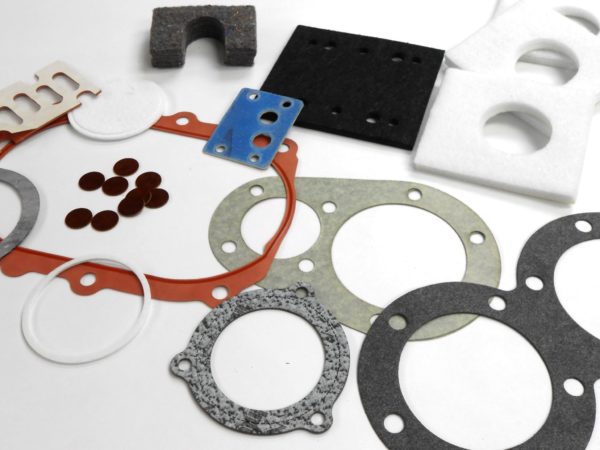
One of the more unique gasket materials used at CGR is a synthetic fiber sheet with a Nitrile binder. This provides superior seal-ability as well as above-average chemical resistance.

Fiber Materials & Converting Capabilities
CGR Products precision converts, slits, laminates, and die-cuts an extensive range of non-asbestos fiber gasket materials, dielectric electrical barrier papers, and thermal insulation media. Please view the table below for a complete list of fiber materials.
| Fiber Materials | Description | Suppliers |
|---|---|---|
| Non-Asbestos Sheeting | Asbestos-free compressed sheet material engineered from synthetic aramid and inorganic fibers with vulcanized elastomeric binders (NBR/SBR). Delivers continuous temperature resistance up to 750°F (spikes to 800°F) and handles operating pressures exceeding 1,200 PSI with excellent torque retention and blowout resistance against water, steam, fuels, and oils. | Thermoseal · Garlock · Klinger |
| Cellulose / Vegetable Fiber | Economical, plant-cellulose-based gasket material treated with chemically resistant gelatin binders. Highly compressible and impermeable; conforms readily to low-bolt-load flanges and rough or warped cast surfaces. Swells slightly in contact with oils to lock the joint against leaks at temperatures up to 250°F. | Vellumoid |
| Beater Addition Materials | Reinforced cellulose/nitrile or synthetic fiber materials manufactured via the beater-addition process. Delivers uniform density, high compressibility, and exceptional resistance to coolants, engine lubricants, and transmission fluids under operating temperatures from 250°F to 550°F. | Alkegen · Armstrong |
| Insulating Papers & Barriers | Flame-resistant, high-dielectric materials engineered for electrical and thermal isolation. Highly resistant to mechanical tear, puncture, radiation, and chemical exposure across temperatures up to 428°F (220°C). Widely specified for transformer windings, EV battery modules, and electrical switchgear barriers. | Nomex · Formex · 3M™ Thermovolt · 3M™ Cequin |
| Fish Paper / Vulcanized Fiber | Extremely durable, flexible fibrous dielectric paper. Resists moderate heat and mechanical abuse; ideal for high-wear electrical coil wrapping, motor slot liners, bus bar isolation, and appliance controls. | FiberFrax · Vellumoid |
| Ceramic Fiber Insulation | Specialty refractory spun alumina-silica fiber products providing extreme thermal management. Features low thermal conductivity, high thermal shock resistance, and non-combustibility for continuous temperatures up to 2,300°F (1,260°C). | Fiberfrax |
| Felt (Wool & Synthetic) | Produced by matting, condensing, and pressing natural wool or synthetic fibers together. Widely utilized for oil wicking, grease retention, dust exclusion, anti-squeak/anti-rattle NVH damping, and mechanical cushioning across SAE F-1 through F-55 specifications. | Felters · Buffalo Felt · Carpenter |
| Fiberglass Insulation | High-efficiency thermal and acoustic barrier blankets that reduce heat loss in process piping, vessels, and exhaust systems while providing fire, vibration, and corrosion protection. | Johns Manville |
| 3M™ Thinsulate™ Products | Acoustic and thermal microfiber web with outstanding sound absorption coefficients. Highly compressible, non-linting, hydrophobic, and lightweight; surface-treated on both sides with protective polyolefin scrims for clean die-cutting and door/pillar cavity filling. | 3M™ |
| Polyester Batting & Shoddy | High-loft nonwoven polyester batting and recycled shoddy fibers engineered for broad-frequency sound dampening, NVH noise reduction, and thermal insulation in automotive and equipment interiors. | Hendrix · Vita |
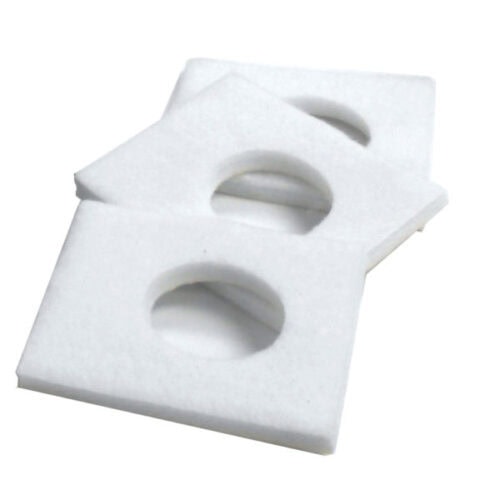
The use of fiber gasket materials can be seen across a number of industries specifically where water or steam is present. The products also provide resistance against mild chemical and mild alkalis exposure.
Fiber material is some of the most temperature resistant and is able to withstand constant temps of 550° F up to 800° F maximum spikes. The material is non-oxidizing and provides synthetic withstanding of weathering and moisture damage. Products made of this material are also very durable and able to perform even against max pressures up to 1200 PSI.
The fiber gasket materials we carry are available in a wide range of standard and non-standard sizes. Our typical sheet sizes are 30” X 30” or 60” X 60” in thicknesses of 1/32”, 1/16”, or 1/8”. Please contact us for more information about the products we carry or for details on acquiring non-standard materials.
Fiber gasket materials can be manufactured for a wide range of custom applications. Because of their physical and internal durability and chemical properties fiber products really are viable for almost any industry. For more information on custom gaskets and seals please contact us today.
Frequently Asked Questions: Engineered Fiber Gaskets & Converting
What replaced asbestos in modern high-temperature industrial gaskets?
Modern non-asbestos compressed sheet (CNA) materials replace asbestos fibers with a blend of synthetic aramid fibers (such as Kevlar®), fiberglass, and inorganic mineral fillers bound together with vulcanized synthetic elastomers—most commonly Nitrile (NBR), SBR, or EPDM. This combination delivers equivalent or superior tensile strength, blowout resistance, and continuous temperature endurance up to 750°F (400°C) and pressures over 1,200 PSI without health or regulatory hazards.
What is the primary difference between vegetable fiber and non-asbestos sheet?
The primary differences center on temperature limits and flange compliance:
- Vegetable / Cellulose Fiber (e.g., Vellumoid): Made from chemically treated plant cellulose fibers. It is designed for low-to-moderate temperatures (up to 250°F) and excels at sealing irregular, rough, or lightly bolted cast-metal flanges because it is soft and swells slightly when contacted by oils, creating a tight mechanical seal.
- Compressed Non-Asbestos Sheet: A rigid, high-density composite engineered for extreme bolt pre-loads, high internal system pressures, steam lines, and continuous temperatures exceeding 500°F to 750°F where vegetable fiber would char and fail.
How does CGR Products ensure tight tolerances when cutting tough non-asbestos fiber sheets?
Non-asbestos compressed fibers are dense, rigid, and abrasive to standard cutting tooling. CGR Products utilizes high-tonnage mechanical flatbed presses with hardened tool-steel dies for high-volume stamped gaskets, and multi-head CNC abrasive waterjet cutting systems for thick sheets, complex geometries, and low-to-medium runs. CNC waterjet cutting eliminates tool wear, provides precise bolt-hole centers, and generates zero heat-affected zones or fiber edge fraying.
Which dielectric fiber materials are used for electrical and battery insulation?
For electrical isolation and flame barriers, CGR Products converts three primary materials:
- Nomex® Aramid Paper: High dielectric strength, thermal endurance up to 428°F (220°C), and UL 94 V-0 flame resistance for transformer and motor slot insulation.
- Formex™ Polypropylene: Highly scoreable, thermoformable dielectric barrier material widely used in power supply baffles and EV battery module enclosures.
- Vulcanized Fiber (Fishpaper): Tough, puncture-resistant cellulose paper offering high dielectric barrier protection combined with extreme mechanical resistance to abrasion.
Can pressure-sensitive adhesive (PSA) be laminated to fiber gasket materials?
Yes. CGR Products utilizes rotary hot-roll lamination to apply high-temperature acrylic and synthetic rubber transfer adhesives to compressed non-asbestos, vegetable fiber, and dielectric papers. Supported transfer tapes featuring polyester or tissue carriers are commonly selected to add dimensional stability, making thin fiber gaskets easier to handle and position on high-speed OEM assembly lines.
Engineered Fiber Gaskets Scaled for High-Volume OEMs
CGR Products partners with leading automotive, industrial compressor, and appliance OEMs to engineer custom non-asbestos and dielectric fiber gaskets. From compound validation and bolt-torque calculations to high-capacity CNC waterjet cutting and die stamping, our multi-facility converting ensures dependable production delivery.