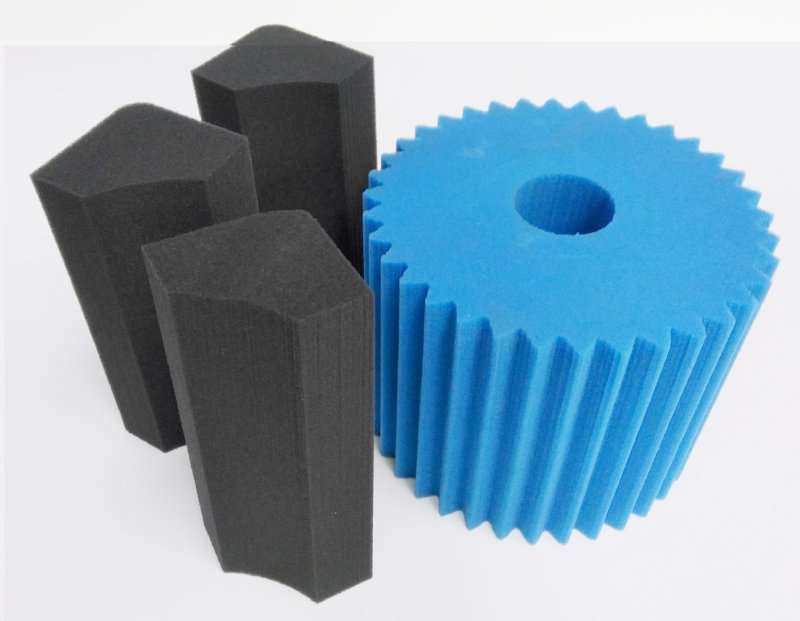
The Custom Fabrication Process: From Concept to Component
Custom fabrication is more than just cutting shapes; it is a high-tech manufacturing discipline that transforms raw materials into functional industrial parts. At CGR Products, we follow a rigorous multi-step process to ensure every gasket, seal, and component meets exact specifications.
Step 1: Design and Engineering Consultation
Every successful project begins with a deep dive into the application’s requirements. Our engineers work with you to analyze:
-
Environmental Factors: Will the part be exposed to UV, extreme temperatures, or chemicals?
-
Tolerance Requirements: Does the application require standard tolerances or high-precision accuracy (e.g., $\pm$ 0.005″)?
-
Material Selection: Choosing from our extensive inventory, including 3M adhesives, Rogers PORON® foams, and various elastomers.
Step 2: Prototyping and Toolless Development
Before moving to high-volume production, we often utilize “soft-tooling” or toolless methods to create functional samples.
-
Waterjet Cutting: Ideal for thick materials (up to 9″) or complex shapes where heat distortion must be avoided.
-
Digital Knife Cutting: Perfect for rapid prototyping of thin-gauge materials without the upfront cost of a steel rule die.
-
CAD Optimization: We use advanced software to ensure the digital design is optimized for maximum material yield (nesting).
Step 3: Material Preparation and Lamination
Many precision-converted parts require multiple layers. In this stage, we combine substrates with high-performance adhesives.
-
Hot Roll Lamination: Using heat and pressure to ensure a permanent bond between the material and the pressure-sensitive adhesive (PSA).
-
Custom Slitting: We slit master rolls down to the specific width required for the final production run, ensuring zero waste at the edges.
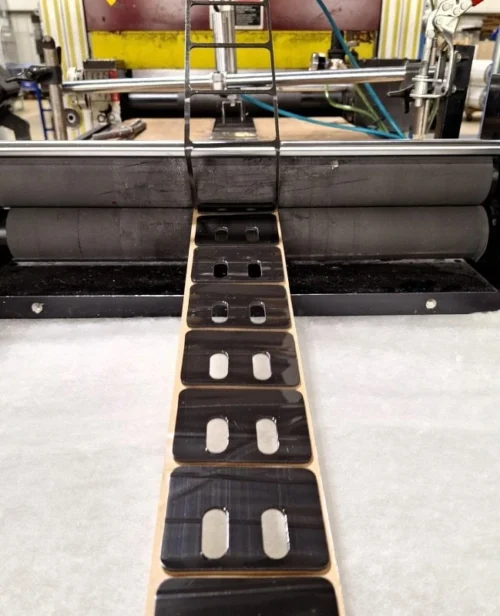
Step 4: Precision Converting Services
Depending on the volume and complexity, we select the most efficient cutting method:
-
Rotary Die Cutting: Best for high-speed, high-volume runs, especially for kiss-cutting parts onto a roll for easy “peel and stick” application.
-
Flatbed Steel Rule Die Cutting: A cost-effective solution for large-format parts or medium-volume production runs.
-
Through-Cutting: Cutting through both the material and the liner to produce individual, loose pieces.
Step 5: High-Tech Quality Inspection
Quality is non-negotiable. We utilize a suite of advanced inspection tools to verify every dimension:
-
Virtek LQC Scanners: This laser inspection system compares the finished part directly to the CAD file in seconds, ensuring 100% accuracy.
-
SPC (Statistical Process Control): We monitor production data in real-time to maintain consistency throughout the entire run.
-
First Article Inspection: Before the full run begins, the first parts are meticulously checked against the original blueprints.
Step 6: Value-Added Finishing and Kitting
The custom fabrication process doesn’t end at the cutting table. We offer several secondary operations to streamline your assembly line:
-
Kitting: Grouping multiple different parts into a single package for easy technician access.
-
Custom Labeling: Adding barcodes or part numbers directly to the components or packaging.
-
Specialized Packing: Ensuring parts are shipped on rolls, sheets, or in individual bags according to your assembly requirements.