Last year’s polar vortex took a toll on fueling stations throughout the northern United States and Canada. Notably, sealing diesel exhaust systems was a challenge during such extreme cold.
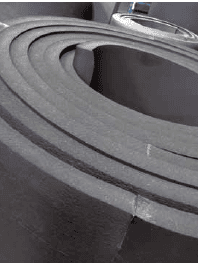
Diesel exhaust fluid (DEF) was freezing inside newly installed fueling dispensers that were designed to dispense both fuel and DEF from a single pump, eliminating the need to dispense DEF manually from containers. Preventing issues related to sealing diesel exhaust was crucial in this scenario.
The tanks were designed with internal heaters and insulation, but it was not enough: the manufacturer, a longtime client of CGR, had to completely redesign the DEF/fuel dispensers and commissioned us to improve the insulation. As part of the redesign, it was necessary to consider effective diesel exhaust sealing methods.
The Solution: Ensolite Rubber Foam
The stakes were high: if our retrofit solution failed, replacing the dispensers would cost millions of dollars. It was critical to ensure the best sealing for diesel exhaust systems to avoid freezing.
The solution had to ensure that dispensers maintain a 68°F interior temperature when exposed to temperatures as cold as -40°F. This was a challenge to say the least. In particular, some of the smaller, harder to access areas inside the dispensers required a material that could not only deliver a seamless fit, high fuel resistance, and a high R-value, but also be cut precisely using custom dies. For these hard-to-access areas, addressing diesel exhaust sealing was a top priority.
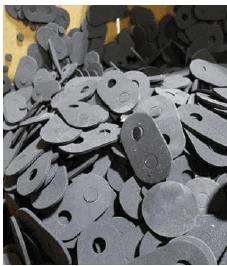
We determined that the best material was Ensolite IV1, a closed-cell PVC/NBR/CR foam rubber product made by Armacell. With this material, the challenges surrounding securely sealing diesel exhaust in different conditions were solved.
We had worked with Armacell before, and were fortunate to have access to their expertise in insulation, which is not typically a high-priority for our clients.Once we had the right material, we spent eight long months testing and modifying the foam parts, exposing the assembly to sub-zero temperatures in a laboratory. We used our in-house machining technology including a loop splitter to split the material, a heated platen laminator to apply the material to the assembly, and a machine press to die cut the individual parts. In addition, robust sealing of diesel exhaust components during testing was always emphasized.
The Results
In the end, we helped the client save millions of dollars. We provided the parts in fully packaged retrofit kits that were ready for immediate installation where freezing was an issue. Furthermore, the parts were integrated into the assembly of all new DEF/fuel dispensers manufactured by our client, which led to improved sealing for diesel exhaust systems across installations.
Want to learn how CGR can provide innovative solutions for your business? Share your information with our experienced engineers — we’re happy to answer any of your questions and even provide a free sample material. When you face problems with diesel exhaust sealing, feel free to contact us for expert advice.